Sovereign Multi-node Universal Retrieval Framework.
The new standard for sovereign document intelligence.
Your documents. Your hardware. Your jurisdiction. No cloud leakage. No compromise.
A document system that uses AI only when necessary, runs where and when you decide, answers to your jurisdiction, and scales without cloud dependency.
It treats your data as property with a purpose — not as inventory in a remote warehouse.
The Octopus Principle. More than 80% of an octopus's intelligence sits in its arms. S.M.U.R.F. works the same way: a pragmatic,
stateless process engine delegates to targeted tools and toolchains, so no single large model has to reason, plan, and act in a loop....
producing faster, more predictable processing without the exponential hallucination risk of reason-then-act (ReAct) architectures.
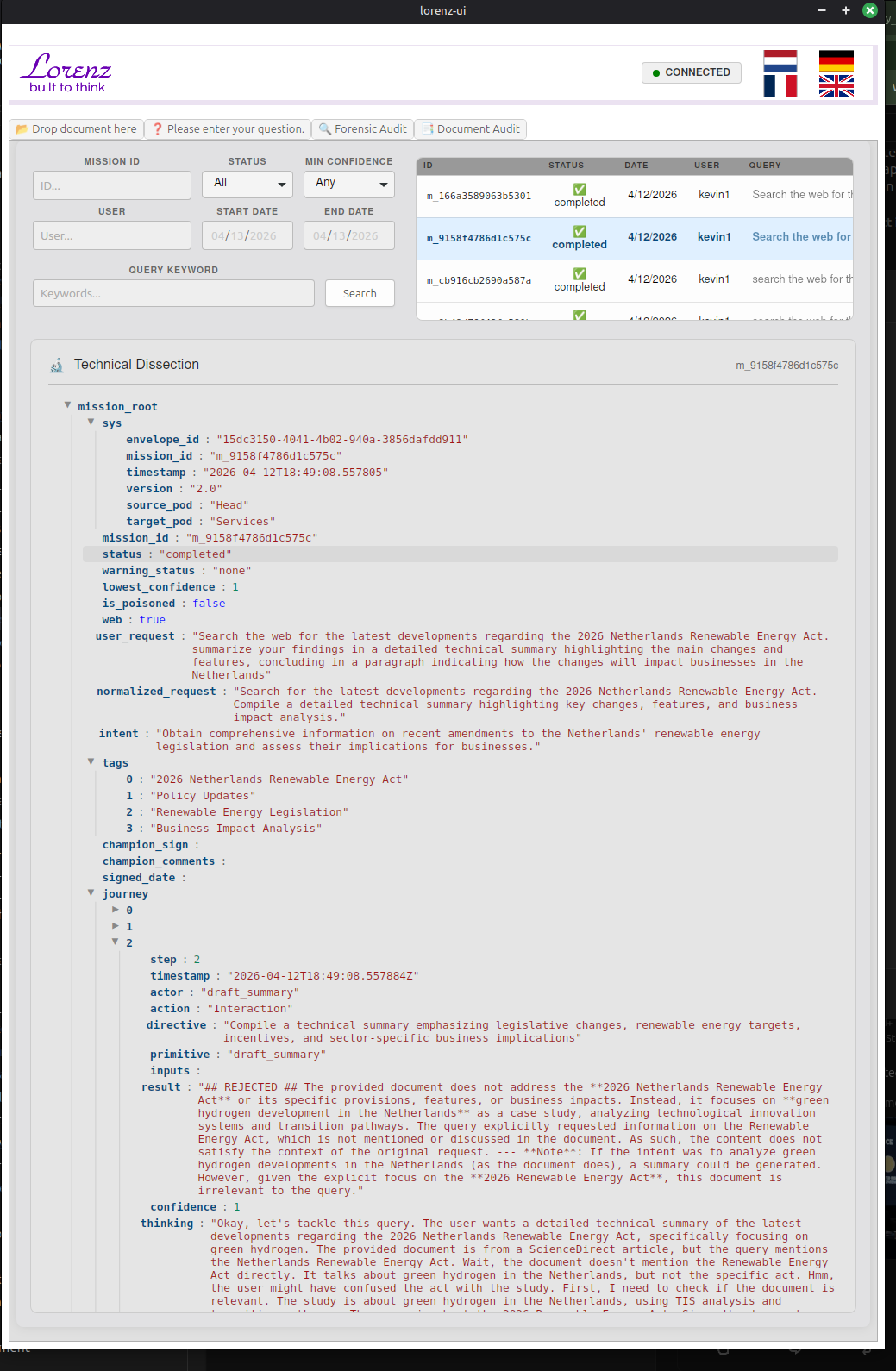
Data-driven processing. The state object is the heart of every workflow, and every state change is recorded. Every document
and every work request becomes fully traceable and forensically auditable by design.
One node or one thousand. Each node is a system node. The cluster is decentralised intelligence with no single point of failure —
resilient, self-managing, and as responsive at 200 million documents as it is at two hundred thousand.
Managed, not stored. Your data is not a lake to be dredged. It stays in its own pools, with the system navigating between them.
Search stays instant no matter how large the whole appears to be.
The result: reliable intelligence you own, compliance you can prove, infinite expandability, and retrieval that does not slow
down as you grow.
Sovereign
Built for the EU AI Act. Isolated from the US Cloud Act.
The EU AI Act demands strict transparency, immutable auditability, and absolute data governance. S.M.U.R.F. delivers all three as
intrinsic properties of the architecture: every mission is traceable, every state change is persistently recorded, and
all your data remains in your own house.
Failure is a valid result. Active agents do not guess. They are coded to return a clear failure — with reasoning —
when the evidence is insufficient. A rejected result with an explanation is worth more than a confident hallucination.
Simultaneously, the US Cloud Act permits foreign authorities to compel US cloud providers to surrender data stored anywhere on earth —
including within the EU. S.M.U.R.F. neutralizes this exposure completely. It executes exclusively on your hardware, inside your perimeter,
under your sovereign jurisdiction. No foreign data reach. No third-party tokenizers. No cross-border inference leakage.
The architecture runs fully air-gapped. Zero internet connectivity required. No external API calls to leak prompts, sensitive metadata,
or proprietary intellectual property. No unexpected terms-of-service revisions reclassifying your corporate assets as training fuel for
someone else's model.
You do not ask permission from a hyper-scaler. You do not re-engineer when global regulations shift. You own the stack, the data, and the
audit trail natively.
Forensic audit trail — every mission, every state change.
The result: custody you can defend, compliance you can legally prove, and an intelligence system that answers exclusively to your board —
not to a legal team in another hemisphere.
Multi-node
From one node to a national network. No central brain required.
S.M.U.R.F. is not a monolith. It scales by addition, not by replacement with a bigger box, and not by expanding a cloud subscription. It is a distributed node architecture where every node is a complete, autonomous system node. It scales horizontally from one all-purpose node to potentially thousands of nodes with separate purposes. The nodes, and the cluster, are self-configuring. Add nodes to add capacity. Lose a node, and the cluster continues to run. Lose a network link and the cluster reroutes, and the separated parts run as separate autonomous clusters until the link is reinstated. There is no central controller to fail.
Each node runs the full stack required for its role — ingestion, inference, graph, storage, messaging — or any combination. Workload distribution is handled by the nodes themselves, not by a cloud orchestrator. In addition, every node functions as the system node. The result is a resilient, self-managing cluster that grows linearly with hardware.
Run it on a single workstation for development, a rack in your data centre for production, or across multiple sites for national-scale resilience. All communication stays inside your network. No WAN dependency.
No massive registry stored on the fragile, single failure point of a master controller or dedicated system node, and no surprise egress bills.
User interface access is via a simple API managed by any of the workstation server nodes, which makes the system, large or small, accessible from any typical, configurable productivity tool suite.
For operators, this means predictable scaling. For executives, it means no vendor lock-in. For integrators, it means S.M.U.R.F. drops into your existing infrastructure instead of replacing it.
The result: infrastructure that grows with your data, survives node failure, and never phones home.
Universal
Any company, any application. Extendable by design, not by replacement.
S.M.U.R.F. separates intelligence from architecture. Every capability — ingestion, classification, reasoning, retrieval, audit — is implemented as a route through a succession of primitives: a primitive is a single-purpose, self-contained execution unit with its own endpoint intelligence. You do not rebuild the system to add a new capability. You add a primitive.
Adding a primitive is a simple process. Design and test the primitive in isolation, register it, and install it. The cluster manages its own update cascade and ensures every node receives the registry updates and primitive code. The same process also applies to automated routes and system command routes.
Because every node is a full system node, primitives can run anywhere. The same primitive can execute on a workstation, a GPU node, or across the cluster. Workload placement is configuration, not re-architecture.
Integration is through a clean, predictable HTTP API. A Nextcloud app, an Office EU connector, a custom front-end, or an existing line-of-business system can all call the same primitives the internal UI uses. No proprietary client required for everyday activities. No single-vendor lock-in.
New document type, new compliance rule, new model, new connector — add the primitive, update the registry and route plan, and deploy. The existing cluster keeps running.
S.M.U.R.F. software adapts to the business rather than the business adapting to the software. It upgrades without forklift migrations. It fits into existing ecosystems like MS365 local, LibreOffice, Nextcloud, and Office EU with minimal development effort.
The result: a framework that grows by addition, connects without coercion, and never forces a rip-and-replace.
Retrieval
One tick of the clock. At any scale.
Modern, cloud-based systems tend to treat data assets as a huge lake. In reality, it is more like a collection of small pools. For this reason, most retrieval systems slow down exponentially as the document count grows.
S.M.U.R.F. does not. The architecture separates storage from navigation: documents stay in managed pools, while the retrieval layer traverses a graph of relationships, tags, and security gates. The result is sub-second response whether you are querying two million documents or two hundred million.
The system understands documents before it searches them. A three-pass tagger classifies source, type, purpose, and intent, extracts semantic noun chunks across languages, and ranks relevance before the query is even asked. When a user asks a question, the system already knows where the answer lives.
Security is not an afterthought. Every query is evaluated against precomputed access gates before retrieval begins. Users only see what they are allowed to see, and the enforcement happens inside your infrastructure, not in a remote permission service.
The result: competitive speed without compromise... no indexing treadmill... no surprise latency spikes at 2am ... and the same HTTP API returns the same shaped result at every scale.
Join the standard
Deploy once. Own it forever.
Starting Q4-2026, we are open for discussions regarding collaboration opportunities with system integrators and sovereign software companies to embed, extend, integrate and package the framework.
 Sovereign